Minds IN Order for Benefits Consultants
A behavioral health program your clients can offer — with measurable cost savings and zero integration friction.
Serious mental illness drives some of the highest-cost claims in your clients' benefits plans — hospitalizations, extended disability, and workplace crises. Minds IN Order is a structured self-management program that reduces those costs. Employees enroll confidentially, build self-awareness through daily check-ins and AI coaching, and respond before things escalate. Your clients get aggregate outcomes data — not clinical content. The program works alongside existing EAP and benefits, costs $100/seat/year, and can pilot with as few as 50 seats.
The Problem You Already Know
Behavioral health is one of the fastest-growing cost categories in your clients' benefits plans. Serious mental illness drives some of the most expensive claims: psychiatric hospitalizations, extended disability leaves, ER visits, and the downstream impact on co-workers and productivity.
EAPs weren't built for this population. Most offer a handful of counseling sessions and a referral list. For employees managing serious mental illness, that's not enough — and your clients are seeing it in their claims data.
Minds IN Order fills that gap: a structured, digital self-management program purpose-built for serious mental illness, designed to work alongside existing benefits — not replace them.
Numbers You Can Put in Front of a CFO
One psychiatric hospitalization costs $7,000–$12,000. One extended disability leave costs far more — in direct benefits, lost productivity, and co-worker burden. Multiply that across your clients' workforces and behavioral health becomes one of the most expensive benefit categories on the books.
The program costs $100 per seat per year. The math speaks for itself — and it's the kind of math a VP of Benefits or CFO can act on.
What You're Recommending
The program works alongside your clients' existing EAP and benefits — not as a replacement for medication or therapy.
Daily Check-ins
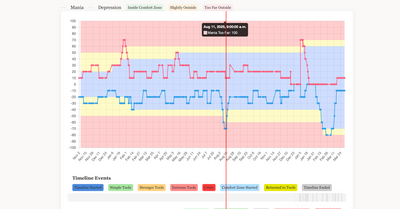
A 30-second daily check-in captures mental state, environment, behavior, and tool usage. Over time, this builds the dataset that drives reports and pattern recognition.
AI Coaching
AI-assisted reflection that reinforces self-awareness and helps users recognize patterns. Explicitly scoped to coaching — not clinical advice.
Graduated Response Plans
When check-in data shows a trend outside the comfort zone, the program walks the user through a stepped response — starting with awareness, progressing to stronger tools when needed.
Tool Effectiveness Tracking
The program tracks which coping strategies each person uses, how often they help, and in what context — building a personalized toolbox that gets more effective over time.
What Your Clients See
Aggregate Engagement Metrics
Usage stats across the enrolled population — check-in rates, lesson completion, program activity trends. Enough to know the program is being used, without seeing what anyone logged.
Enrollment Management
Manage seats, track participation, and monitor enrollment across the cohort from a dedicated partner admin dashboard.
Outcomes Data
Cost and utilization reports for the cohort — the kind of structured data that demonstrates program value to a CFO, a board, or a benefits committee.
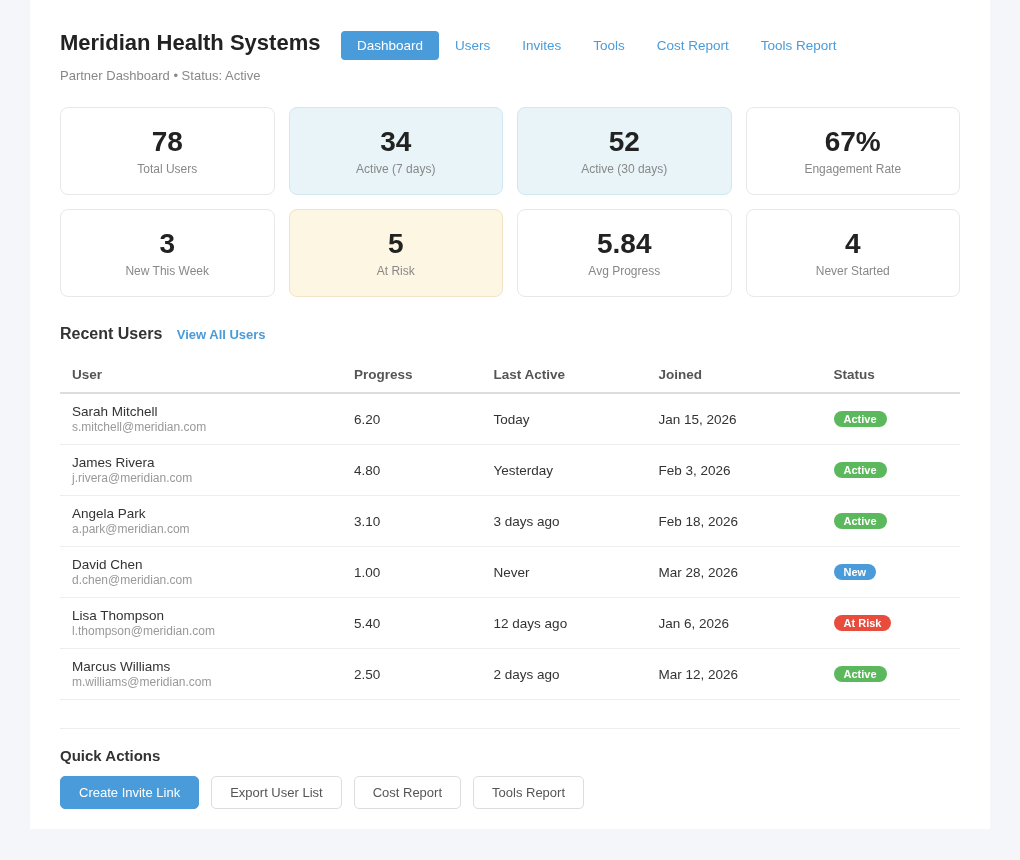
Partner admin dashboard (sample data)
Your clients see aggregate program data — never individual employee check-ins or clinical content. Employee participation is confidential by design.
Easy to Pilot, Easy to Prove
$100 per seat per year. Even 50–100 seats is a viable pilot.
Employees enroll confidentially. Your client sees aggregate engagement data — not individual clinical content. Within the first year, they can measure the program's impact against their own claims and utilization data.
No long-term commitment required to start. No integration with the benefits platform needed. Employees access the program directly. Low risk for the client, easy win for your book of business.
HIPAA-Compliant Architecture
All authentication events and PHI (protected health information) access are logged in a comprehensive audit trail. Data sharing access is tracked per-grantee. Admin impersonation is fully logged. The system supports data export for compliance requests.
HIPAA-compliant architecture: bcrypt password hashing, TOTP two-factor authentication, CSRF token rotation, PDO prepared statements, rate-limited login, Cloudflare Turnstile CAPTCHA. Config files stored outside the web root. Role-based access controls separate user, partner admin, and system admin capabilities. All authentication events and data access are audit-logged.
HIPAA Business Associate Agreement signed with AWS. All protected health information encrypted at rest and in transit.
Clinical Evidence
Tufts University Pilot Study
Dr. Nassir Ghaemi, Professor of Psychiatry at Tufts University School of Medicine, conducted an unpublished pilot study of the Bipolar IN Order program. 19 participants completed an 8-week program and were assessed using the validated WHO Quality of Life scale.
| Domain | Before | After | Change |
|---|---|---|---|
| Physical Health | 56.6 | 66.4 | +9.8 points |
| Social Relationships | 50.8 | 55.9 | +5.1 points |
| Psychological Health | 57 | 59.4 | +2.4 points |
| Environment | 71.9 | 73.8 | +1.9 points |
"A symptomatic benefit comparable to currently available medication. When added adjunctively to medications, the program also produces quality of life benefits not seen after psychopharmacological treatment alone."
Federal Review (PCORI)
Reviewed by the Patient-Centered Outcomes Research Institute. Reviewer-identified strengths:
- Innovative focus on patient-centered outcomes and functionality vs symptom reduction
- Pilot study shows improvement in 3 of 4 WHO-QOL assessments, demonstrating potential impact
- Addresses a critical gap in current clinical treatment
- Strong patient and stakeholder panel
Endorsements
- Dr. Nassir Ghaemi — Tufts University (Mood disorders, psychopharmacology)
- Prof. Jim van Os — Maastricht / Utrecht University (Netherlands) (Recovery-oriented psychiatry, dimensional models)
- Dr. Eduard Vieta — University of Barcelona (Spain) (Bipolar disorder research (one of the most cited in the field))
- Dr. Sabine Bahn — University of Cambridge (UK) (Biomarkers, mood disorders)
- Dr. Hilary Blumberg — Yale School of Medicine (Mood Disorders Research Program Director)
- Dr. Stephen Hinshaw — UC Berkeley (Dept of Psychology, Chair)
In 2014, medical directors at Blue Cross Blue Shield provided letters of support for the program.
23 Years of Development

Minds IN Order has been in continuous development since 2003. What started as in-person workshops has been refined into a fully digital, standardized program. Studied at Tufts University. Reviewed by PCORI. Endorsed by researchers at Yale, UC Berkeley, Maastricht University, and the University of Barcelona.
In continuous use since 2003 — from in-person workshops to the current digital platform. Now scaling through clinical partnerships and institutional pilots.
Let's Talk
Questions? Contact us