Minds IN Order for Health Systems
Structured behavioral health self-management — with population-level outcomes data and zero EHR integration required.
Patients log daily check-ins, track what works, and get AI coaching between visits. Clinicians get structured between-visit data when patients share reports — no software to install. Your institution gets aggregate engagement metrics and cost/utilization reports across your behavioral health population. The program runs itself. $100/seat/year. No EHR integration needed to start.
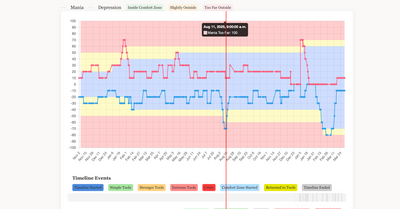
What Happens Between Visits
Your behavioral health patients are seen monthly — sometimes less. Crises develop between visits. Clinicians walk into appointments with no structured data about what happened since last time — just a patient's recall, filtered through how they feel today.
That gap is where psychiatric readmissions start. It's where ER visits originate. And it's where your quality metrics are won or lost — because by the time a patient is back in your system, the crisis has already happened.
Minds IN Order fills that gap: a structured self-management program for serious mental illness that runs between visits, collects daily data, provides AI coaching, and gives your institution population-level visibility into your behavioral health caseload.
Two Stakeholders, One Program
For Your Population Health & Administration Team
Aggregate engagement metrics across your behavioral health population. Cost and utilization reports you can use in value-based care reporting, HEDIS quality measures, and grant applications. Measurable reduction in projected behavioral health costs — data your CMO and CFO can act on.
The program generates the kind of structured outcomes data that CMS quality reviews, CCBHC reporting, and value-based contracts require — without adding work to your clinical staff.
For Your Clinical Directors & Clinicians
The program runs itself. Patients do daily check-ins and get AI coaching between visits. When a patient shares their reports, the clinician gets structured between-visit data — mood trends, tool effectiveness, behavioral patterns — without installing software, learning a new system, or managing another workflow.
Your clinicians benefit without the institution having to train them on anything new. Read-only access to patient-shared data, delivered on demand.
The Math Is Simple
One psychiatric readmission costs $7,000–$12,000. That's a CMS quality measure your institution is already tracking. Multiply avoidable readmissions and ER visits across your behavioral health population and you're looking at one of your most expensive — and most measurable — cost categories.
The program costs $100 per seat per year. A single averted readmission pays for 70–120 seats. You don't need a large cohort to see the impact in your own outcomes data.
What Your Patients Do Between Visits
The program works alongside your existing clinical care — not as a replacement for medication, therapy, or the treatment team.
Daily Check-ins
A 30-second daily check-in captures mental state, environment, behavior, and tool usage. Over time, this builds the dataset that drives reports and pattern recognition.
AI Coaching
AI-assisted reflection that reinforces self-awareness and helps users recognize patterns. Explicitly scoped to coaching — not clinical advice.
Graduated Response Plans
When check-in data shows a trend outside the comfort zone, the program walks the user through a stepped response — starting with awareness, progressing to stronger tools when needed.
Tool Effectiveness Tracking
The program tracks which coping strategies each patient uses, how often they help, and in what context — building a personalized toolbox that gets more effective over time.
What Clinicians See
When a patient shares their reports, the clinician gets structured between-visit data: mood trends, tool effectiveness, and behavioral patterns — organized and ready to use at the next appointment. Read-only access via a secure link. No software to install, no login to manage, no workflow to change.
This isn't a new system for your clinicians to learn. It's data that shows up when patients choose to share it — and disappears from the clinician's workload when the visit is over.
What Your Institution Sees
Aggregate Engagement Metrics
Usage stats across your behavioral health population — check-in rates, lesson completion, program activity trends. Enough to know the program is being used, without seeing what anyone logged.
Enrollment Management
Manage seats, track participation, and monitor enrollment across clinics or departments from a dedicated partner admin dashboard.
Outcomes Data
Cost and utilization reports for your cohort — the kind of structured data that demonstrates program value in value-based care reporting, HEDIS submissions, CCBHC outcome measures, and grant applications.
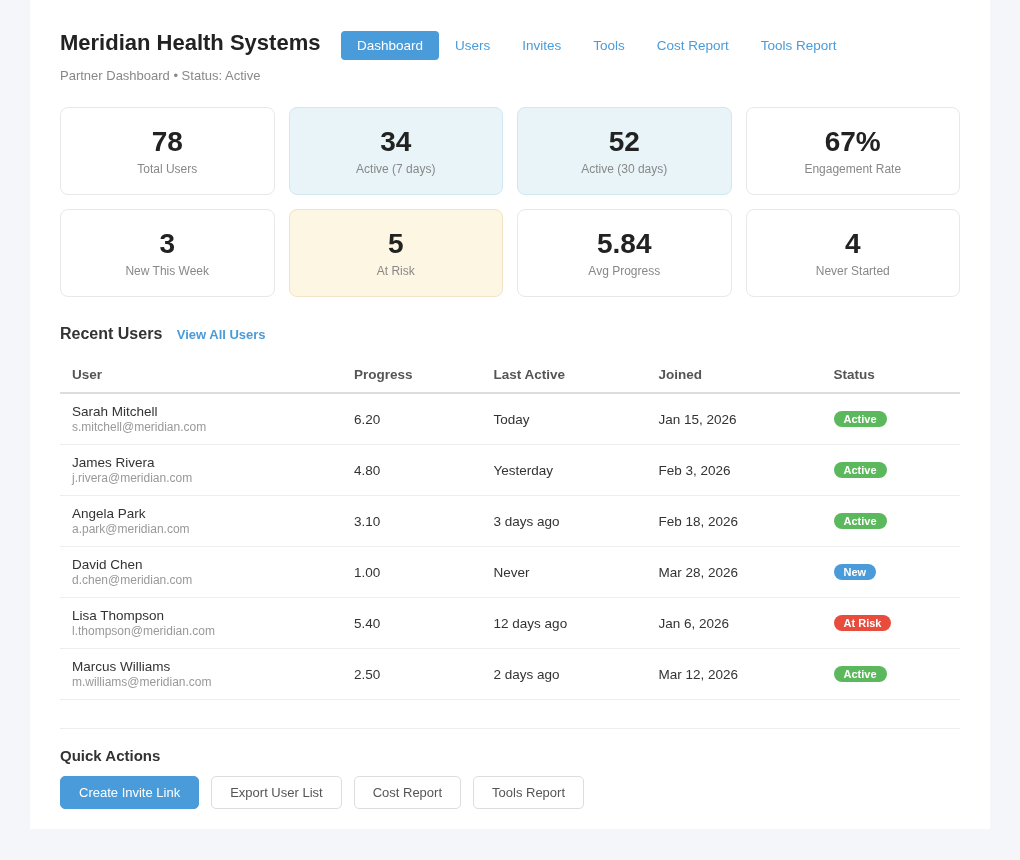
Partner admin dashboard (sample data)
You see aggregate program data — never individual patient check-ins or clinical content. Patient participation is confidential by design.
Start With a Pilot
$100 per seat per year. Even 50–100 seats is a viable pilot.
You can start with a specific clinic, department, or patient panel. Patients access the program directly — no EHR integration needed to get a pilot running. No 18-month IT project. No procurement committee gauntlet before you can see whether it works.
Within the first year, you can measure the program's impact against your own outcomes data — readmissions, ER utilization, patient engagement between visits. For CCBHCs: the program contributes to required evidence-based practice documentation and outcome measures.
Low risk. Measurable in your own data. Deployable now.
HIPAA-Compliant Architecture
You're a covered entity. HIPAA compliance is baseline, not a differentiator. The architecture is built accordingly.
All authentication events and PHI (protected health information) access are logged in a comprehensive audit trail. Data sharing access is tracked per-grantee. Admin impersonation is fully logged. The system supports data export for compliance requests.
HIPAA-compliant architecture: bcrypt password hashing, TOTP two-factor authentication, CSRF token rotation, PDO prepared statements, rate-limited login, Cloudflare Turnstile CAPTCHA. Config files stored outside the web root. Role-based access controls separate user, partner admin, and system admin capabilities. All authentication events and data access are audit-logged.
HIPAA Business Associate Agreement signed with AWS. All protected health information encrypted at rest and in transit.
Clinical Evidence
Tufts University Pilot Study
Dr. Nassir Ghaemi, Professor of Psychiatry at Tufts University School of Medicine, conducted an unpublished pilot study of the Bipolar IN Order program. 19 participants completed an 8-week program and were assessed using the validated WHO Quality of Life scale.
| Domain | Before | After | Change |
|---|---|---|---|
| Physical Health | 56.6 | 66.4 | +9.8 points |
| Social Relationships | 50.8 | 55.9 | +5.1 points |
| Psychological Health | 57 | 59.4 | +2.4 points |
| Environment | 71.9 | 73.8 | +1.9 points |
"A symptomatic benefit comparable to currently available medication. When added adjunctively to medications, the program also produces quality of life benefits not seen after psychopharmacological treatment alone."
Federal Review (PCORI)
Reviewed by the Patient-Centered Outcomes Research Institute. Reviewer-identified strengths:
- Innovative focus on patient-centered outcomes and functionality vs symptom reduction
- Pilot study shows improvement in 3 of 4 WHO-QOL assessments, demonstrating potential impact
- Addresses a critical gap in current clinical treatment
- Strong patient and stakeholder panel
Academic Endorsements
- Dr. Nassir Ghaemi — Tufts University (Mood disorders, psychopharmacology)
- Prof. Jim van Os — Maastricht / Utrecht University (Netherlands) (Recovery-oriented psychiatry, dimensional models)
- Dr. Eduard Vieta — University of Barcelona (Spain) (Bipolar disorder research (one of the most cited in the field))
- Dr. Sabine Bahn — University of Cambridge (UK) (Biomarkers, mood disorders)
- Dr. Hilary Blumberg — Yale School of Medicine (Mood Disorders Research Program Director)
- Dr. Stephen Hinshaw — UC Berkeley (Dept of Psychology, Chair)
In 2014, medical directors at Blue Cross Blue Shield provided letters of support for the program.
23 Years of Development

Minds IN Order has been in continuous development since 2003. What started as in-person workshops has been refined into a fully digital, standardized program. Studied at Tufts University. Reviewed by PCORI. Endorsed by researchers at Yale, UC Berkeley, Maastricht University, and the University of Barcelona.
In continuous use since 2003 — from in-person workshops to the current digital platform. Now scaling through clinical partnerships and institutional pilots.
Let's Talk
Questions? Contact us