Minds IN Order for Health System Networks
Structured behavioral health self-management across every facility in your system — with population-level outcomes data and zero per-site IT.
Patients log daily check-ins, track what works, and get AI coaching between visits — at every facility in your system. Clinicians get structured between-visit data when patients share reports. No software to install at any site. Your system gets aggregate behavioral health outcomes segmented by facility, region, or department. One dashboard. One program. $100/seat/year. No EHR integration needed to start.
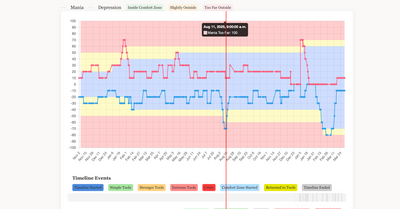
Behavioral Health Across Your System
Your behavioral health patients cycle through ER, inpatient, and outpatient settings across multiple facilities in your system. No single site has visibility into the full picture. A patient discharged from one hospital shows up in crisis at another. Between-visit gaps exist at every facility — and no one is aggregating the data across sites. The result: duplicated effort, missed patterns, and readmissions that show up in your system-wide quality metrics but are invisible at the facility level until they happen.
Minds IN Order fills that gap: a structured self-management program for serious mental illness that runs between visits at every facility, collects daily data, provides AI coaching, and gives your system population-level visibility across your entire behavioral health caseload.
One Program. Every Facility.
The same program runs at every facility. Patients access it directly — no per-site software installation, no per-site IT configuration, no per-site training program. One partner dashboard segments engagement and outcomes data by facility, region, or department. Start with a pilot at one site and scale to the next without redeployment.
Two Stakeholders, One Program
For Your Population Health & Administration Team
System-wide behavioral health engagement metrics across every facility. Readmission reduction data aggregated by site and region. Value-based care contract performance tracking. CMS Star ratings impact data. Board-ready outcomes reporting — the kind your VP of Population Health, system CMO, and quality team need for VBC contract reviews and CMS submissions.
For Your Clinical Directors & Clinicians
The program runs itself at each site. Zero facility-level IT. Zero training budget. Clinicians get structured between-visit data — mood trends, tool effectiveness, behavioral patterns — when patients share their reports. Read-only. No software to install. No workflow to change. And because there is no rollout friction, expanding to the next facility does not require a new training program, onboarding project, or IT ticket.
The Math at Scale
One psychiatric readmission costs $7,000–$12,000 — and at system scale, that cost hits twice: the direct cost of the readmission AND the lost incentive or penalty in your value-based contract. Multiply avoidable readmissions across your behavioral health population system-wide, and you are looking at one of your largest controllable cost categories. At $100/seat/year, if even 1% of your behavioral health population avoids one readmission, the program pays for itself many times over. Frame this against your VBC contract performance and CMS penalty exposure — not just the unit cost of a single bed-day.
What Your Patients Do Between Visits
The program works alongside your existing clinical care — not as a replacement for medication, therapy, or the treatment team.
Daily Check-ins
A 30-second daily check-in captures mental state, environment, behavior, and tool usage. Over time, this builds the dataset that drives reports and pattern recognition.
AI Coaching
AI-assisted reflection that reinforces self-awareness and helps users recognize patterns. Explicitly scoped to coaching — not clinical advice.
Graduated Response Plans
When check-in data shows a trend outside the comfort zone, the program walks the user through a stepped response — starting with awareness, progressing to stronger tools when needed.
Tool Effectiveness Tracking
The program tracks which coping strategies each patient uses, how often they help, and in what context — building a personalized toolbox that gets more effective over time.
What Clinicians See
When a patient shares their reports, the clinician gets structured between-visit data: mood trends, tool effectiveness, and behavioral patterns — organized and ready to use at the next appointment. Read-only access via a secure link. No software to install, no login to manage, no workflow to change. And because there is zero rollout friction, expanding to the next facility in your system does not require a training program, an onboarding project, or an IT ticket. Same clinician experience at every site in the network.
What Your System Sees
Your partner dashboard segments all engagement and outcomes data by facility, region, or department. Your VP of Population Health sees the system-wide view. Facility directors see their own site. Nobody sees individual patient check-ins. This is population-level behavioral health visibility — not a clinical tool, not a patient portal, and not another EHR module.
Aggregate Engagement Metrics
Usage stats across your behavioral health population — check-in rates, lesson completion, program activity trends. Segmented by facility, region, or department. Enough to know the program is being used, without seeing what anyone logged.
Enrollment Management
Manage seats, track participation, and monitor enrollment across facilities from a dedicated partner admin dashboard.
Outcomes Data
Cost and utilization reports across your system — the kind of structured data that demonstrates program value in value-based care reporting, CMS quality submissions, and board-level outcomes reviews.
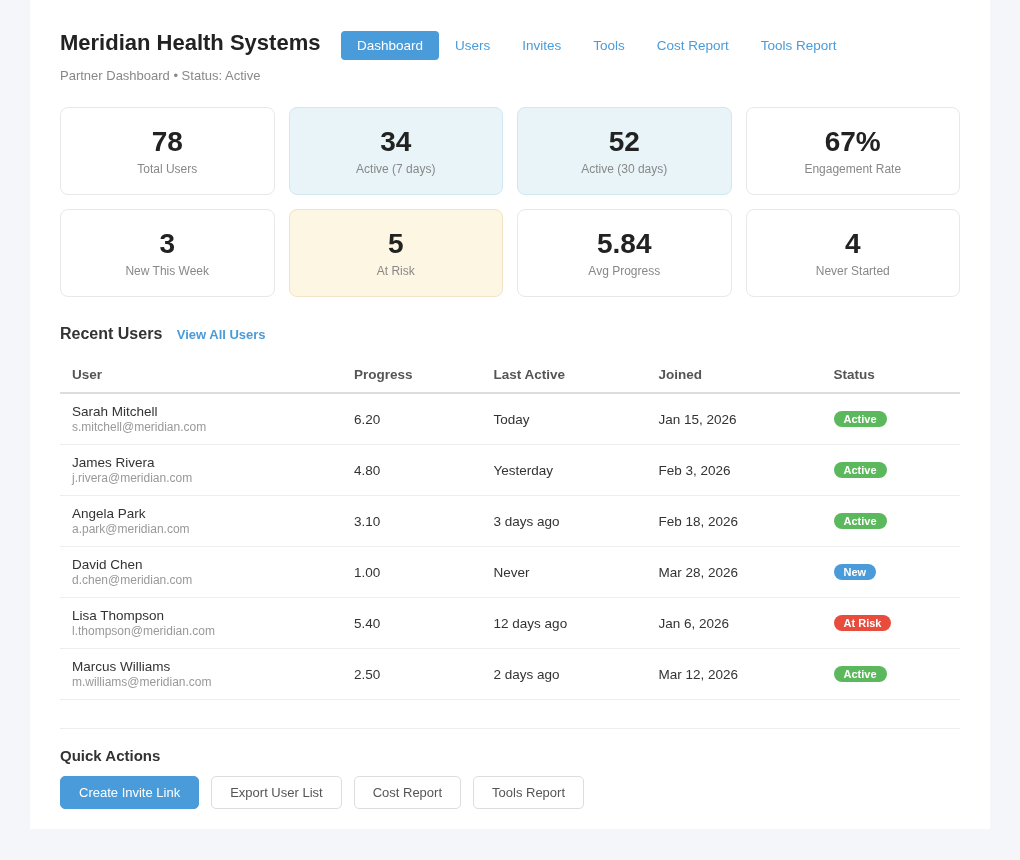
Partner admin dashboard (sample data)
You see aggregate program data — never individual patient check-ins or clinical content. Patient participation is confidential by design.
From Pilot to System-Wide
Phase 1: Pilot
50–100 seats at one facility. 6–12 months. Measurable in your own outcomes data — readmissions, ER utilization, patient engagement. Produces the internal evidence your champion needs to justify expansion.
Phase 2: Expand
Add facilities based on pilot results. Scale the dashboard to show cross-site data. Each new site deploys in days, not months — no per-site IT, no per-site training.
Phase 3: System-Wide
Full behavioral health population across your system. Integrated into quality reporting and VBC contract performance tracking. Board-level outcomes data across every facility. No EHR integration needed at any phase.
Security & Compliance
Built to pass your security review. Your compliance team will run a formal vendor risk assessment — and the architecture is designed for that process. Everything below is what they will find.
All authentication events and PHI (protected health information) access are logged in a comprehensive audit trail. Data sharing access is tracked per-grantee. Admin impersonation is fully logged. The system supports data export for compliance requests.
HIPAA-compliant architecture: bcrypt password hashing, TOTP two-factor authentication, CSRF token rotation, PDO prepared statements, rate-limited login, Cloudflare Turnstile CAPTCHA. Config files stored outside the web root. Role-based access controls separate user, partner admin, and system admin capabilities. All authentication events and data access are audit-logged.
HIPAA BAA signed with AWS. All PHI encrypted at rest and in transit.
Clinical Evidence
Tufts University Pilot Study
Dr. Nassir Ghaemi, Professor of Psychiatry at Tufts University School of Medicine, conducted an unpublished pilot study of the Bipolar IN Order program. 19 participants completed an 8-week program and were assessed using the validated WHO Quality of Life scale.
| Domain | Before | After | Change |
|---|---|---|---|
| Physical Health | 56.6 | 66.4 | +9.8 points |
| Social Relationships | 50.8 | 55.9 | +5.1 points |
| Psychological Health | 57 | 59.4 | +2.4 points |
| Environment | 71.9 | 73.8 | +1.9 points |
"A symptomatic benefit comparable to currently available medication. When added adjunctively to medications, the program also produces quality of life benefits not seen after psychopharmacological treatment alone."
Federal Review (PCORI)
Reviewed by the Patient-Centered Outcomes Research Institute. Reviewer-identified strengths:
- Innovative focus on patient-centered outcomes and functionality vs symptom reduction
- Pilot study shows improvement in 3 of 4 WHO-QOL assessments, demonstrating potential impact
- Addresses a critical gap in current clinical treatment
- Strong patient and stakeholder panel
Academic Endorsements
- Dr. Nassir Ghaemi — Tufts University (Mood disorders, psychopharmacology)
- Prof. Jim van Os — Maastricht / Utrecht University (Netherlands) (Recovery-oriented psychiatry, dimensional models)
- Dr. Eduard Vieta — University of Barcelona (Spain) (Bipolar disorder research (one of the most cited in the field))
- Dr. Sabine Bahn — University of Cambridge (UK) (Biomarkers, mood disorders)
- Dr. Hilary Blumberg — Yale School of Medicine (Mood Disorders Research Program Director)
- Dr. Stephen Hinshaw — UC Berkeley (Dept of Psychology, Chair)
In 2014, medical directors at Blue Cross Blue Shield provided letters of support for the program.
23 Years of Development

Minds IN Order has been in continuous development since 2003. What started as in-person workshops has been refined into a fully digital, standardized program. Studied at Tufts University. Reviewed by PCORI. Endorsed by researchers at Yale, UC Berkeley, Maastricht University, and the University of Barcelona.
In continuous use since 2003 — from in-person workshops to the current digital platform. Now scaling through clinical partnerships and institutional pilots.
Let's Talk
Questions? Contact us