Minds IN Order for Researchers
Structured longitudinal data on bipolar self-management — IRB-ready, de-identified, and growing daily.
The app generates structured, timestamped self-report data across mood, environment, behavior, and tool effectiveness on a daily basis. The dataset is longitudinal, de-identified, and IRB-ready — with a growing user cohort and low attrition. We are looking for research partners interested in self-management outcomes, tool effectiveness, or behavioral pattern data in bipolar disorder.
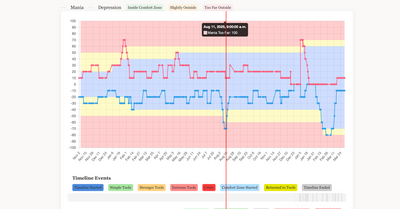
What the Data Looks Like
A 30-second daily check-in captures mental state, environment, behavior, and tool usage. Over time, this builds the dataset that drives reports and pattern recognition.
Daily Check-ins
Each check-in captures: mania % (0–100), depression % (0–100), environment quality, behavior status (IN Order / Dis-Ordered / Out Of Control), and comfort zone position. Timestamped and structured for longitudinal analysis.
Tool Use Events
Every tool use is logged with: what tool was used, immediate effect (worse / same / better / much better), contextual fields (where, when, with whom, how much, how long), whether they'd use it again, and mood state at time of use.
Monthly Surveys (Level 5+)
Monthly surveys (available at Level 5+) capture healthcare utilization — hospitalizations, ER visits, medication changes, work disruptions, and self-ratings. These feed the Medical Utilization and Cost Savings Report that partners use to measure program ROI.
Additional Data
AI conversation logs (with origin context), AI-generated weekly summaries, structured exercise responses, post-check-in reflection prompts, and comfort zone threshold data across six subcategories.
Data Architecture
All data is structured, timestamped, and stored in MySQL 8. De-identified datasets are available for research partnerships. IRB coordination available.
| Data Type | Fields | Frequency | Format |
|---|---|---|---|
| Daily check-in | Mania %, depression %, environment quality, behavior status, comfort zone position | Daily | Numeric + categorical |
| Tool use event | Tool type, immediate effect, context (where/when/who/duration), reuse intent, mood state | Per use | Categorical + free text |
| Monthly survey | Hospitalizations, ER visits, medication changes, work disruptions, self-ratings | Monthly (Level 5+) | Numeric + Likert |
| Environment ratings | Location, social setting, atmosphere, activity — rated separately for mania vs. depression effect | Per exercise | Likert (bipolar-directional) |
| Behavior tracking | Behavior toward others, behavior toward self — per mood state | Per exercise + check-in | Categorical |
| Comfort zone thresholds | Personal functioning thresholds for depression and mania across six subcategories | Set during exercises | Numeric |
| AI conversations | Full conversation logs with origin context and AI-generated weekly summaries | Per session + weekly | Text + structured metadata |
Note: The app does not track medication-specific fields (drug name, dosage, as-prescribed vs. PRN). Medications are tracked through the same general tool framework as non-pharmacological strategies.
Pilot Study: Tufts University
Dr. Nassir Ghaemi, Professor of Psychiatry at Tufts University School of Medicine, conducted an unpublished pilot study of the Bipolar IN Order program. 19 participants completed an 8-week program and were assessed using the validated WHO Quality of Life scale.
The study attracted significant interest from the bipolar community, with 19 participants completing the full program.
"A symptomatic benefit comparable to currently available medication. When added adjunctively to medications, the program also produces quality of life benefits not seen after psychopharmacological treatment alone."
— Ghaemi et al.
| WHO-QOL Domain | Before | After | Change |
|---|---|---|---|
| Physical Health | 56.6 | 66.4 | +9.8 points |
| Social Relationships | 50.8 | 55.9 | +5.1 points |
| Psychological Health | 57 | 59.4 | +2.4 points |
| Environment | 71.9 | 73.8 | +1.9 points |
42% of participants reported being "currently ill" at baseline, compared to only 26% after the program. Awareness of state improved by 10 points. Comfort during episodes improved by 13.3 points. Functioning improved by 5 points.
PCORI Federal Review
We submitted a $2 million research proposal to PCORI (Patient-Centered Outcomes Research Institute), a major federal research funder. The review was rigorous and the feedback was specific.
Innovative focus on patient-centered outcomes and functionality vs symptom reduction
Pilot study shows improvement in 3 of 4 WHO-QOL assessments, demonstrating potential impact
Addresses a critical gap in current clinical treatment
Strong patient and stakeholder panel
The workshop format at the time was not standardized enough to be reproducible in a large-scale study. They were right. So we rebuilt the entire program as a digital platform where every interaction is logged, every outcome is measurable, and the methodology is fully reproducible. The current platform directly addresses every concern PCORI raised.
Institutional Endorsements
| Researcher | Institution | Expertise |
|---|---|---|
| Dr. Nassir Ghaemi | Tufts University | Mood disorders, psychopharmacology |
| Prof. Jim van Os | Maastricht / Utrecht University (Netherlands) | Recovery-oriented psychiatry, dimensional models |
| Dr. Eduard Vieta | University of Barcelona (Spain) | Bipolar disorder research (one of the most cited in the field) |
| Dr. Sabine Bahn | University of Cambridge (UK) | Biomarkers, mood disorders |
| Dr. Hilary Blumberg | Yale School of Medicine | Mood Disorders Research Program Director |
| Dr. Stephen Hinshaw | UC Berkeley | Dept of Psychology, Chair |
In 2014, medical directors at Blue Cross Blue Shield provided letters of support for the program.
Available Reports
The app generates reports that show users how they're doing over time — mood trends, which tools are working, behavioral patterns, and AI-generated insights. Users see their own data. Partners see aggregate outcomes across their cohort — engagement, cost savings, tool effectiveness — but never individual check-in data or conversations.
User-Level Reports (7)
- Full Progress Report
- Doctor/Clinician Report
- Tools Effectiveness Report
- AI Conversations Report
- AI Weekly Summary
- Advanced Analysis + Forecast
- Monthly Survey Review
Population-Level Reports
- Tool Effectiveness (Population)
- Medical Utilization and Cost Savings
Current Sample Size
These numbers update in real time from the production database.
25
Total Enrolled
18
Currently Active
257
Member-Months of Data
28% dropout rate. Longitudinal, structured, and representing real-world outcomes — not a controlled trial population, but naturalistic data with high engagement and low attrition.
23 Years of Development

Minds IN Order has been in continuous development since 2003. What started as in-person workshops has been refined into a fully digital, standardized program. Studied at Tufts University. Reviewed by PCORI. Endorsed by researchers at Yale, UC Berkeley, Maastricht University, and the University of Barcelona.
In continuous use since 2003 — from in-person workshops to the current digital platform. Now scaling through clinical partnerships and institutional pilots.
Research Partnership
Questions? Contact Tom Wootton